Sunday, July 08, 2007


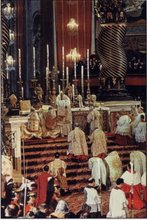
Summorum Pontificum


The Holy Father published the Apostolic Letter Summorum Pontificum given Motu Proprio yesterday. This Apostolic Letter gives priests of the Latin Rite the permission to say the Traditional Latin Mass according to the Missal published by Blessed Pope John XXIII in 1962 without needing permission from their local bishop. It also lays down generous stipulations for the celebration of the traditional Latin Mass with the lay faithful who request it (the official Latin edition is available here; the unofficial English translation is available from Rorate Caeli here).


I have refrained from commenting on this matter; stories of the Letter's publishing have been circulating in the media and on the Internet for over a year. Now that it has been officially published, I wanted to comment on it. While I am not qualified to interpret the content of the Letter in depth, I do want to express my gratitude to the Holy Father for his faithful and generous care of his Traditional flock. I do predict that this will be a great boon to the Traditional cause. I have had my doubts about Benedict's papacy so far, but he has come through for Traditionalists with this Letter. Obviously he knows what he is doing.

Orémus pro beatíssimo Papa nostro Benedicto. Dóminus consérvet eum, et vivíficet eum, et beátum fáciat eum in terra, et non tradat eum in ánimam inimicórum ejus.--Let us pray for our most blessed Pope Benedict. The Lord preserve him and keep him alive, that he may be blessed upon earth ; and deliver not thou him into the will of his enemies.

Tuesday, July 03, 2007

The Fourth of July

As a monarchist I always feel conflicted on the Fourth of July, the day we Americans celebrate our independence from Great Britain. I feel conflicted because I do not believe we--I say we as if I had any say in the matter--should ever have declared independence from Britain. The colonists didn't have it so bad, and besides, the war of Rebellion (also known as the Revolutionary War) was not then nor could be now justified under the Catholic just war doctrine.


With that said, the 4th is a popular holiday here in America. It's a time for friends and family, barbecues, and fireworks. Who doesn't like these things? So I usually find myself partaking in certain parts of the holiday while maintaining a spirit of disapproval of why we are celebrating. So if you're an American monarchist and you find yourself in a Fourth of July celebration, make a toast to King George III and his successor Elizabeth II--our ancestors never knew they had it so good.

Wednesday, June 13, 2007

The Novus Ordo Mentality

The father of a long time friend died late last month, and I attended his "memorial" service shortly thereafter. My friend's father was Catholic, and so naturally his service was a Catholic one. It wasn't a Mass, but I thought I knew what I was going to experience due to my previous experiences at Novus Ordo Masses (for new readers, I converted to Catholicism 11 years ago in a Novus Ordo parish and made the move 4 years ago to an indult Latin Mass community). It turns out I wasn't prepared for what I was about to experience.

When I showed up at the small church, I remarked just how loud it was. Everyone was sitting in the pews visiting loudly--and by loudly I mean very loudly. It reminded me of the noise level in a school gymnasium before an assembly or basketball game. Churches are a place of prayer and worship, not socialization. I was so struck by people's lack of respect for the house of God, and for God Himself present in the tabernacle.

As I went to my pew, I genuflected, made the sign of the cross, and knelt in prayer. I observed no other person doing the same. Here we were at the memorial service of a dead man, and no one prayed privately for the repose of his soul.

The service was full of the cliched Novus Ordo "hymns" such as "Be Not Afraid," "We Will Run and not Grow Weary," and the classic funeral song "On Eagle's Wings." No Gregorian chant, in fact no Latin at all. The priest's vestments were white--no black at this service. The prayers were such that it seemed as if it was beyond doubt that this dead man was indeed in Heaven--I thought only the Pope could canonize people?

Then I was thrown a curveball--instead of the priest giving the sermon, a nun (of course without habit, or anything at all indicating she was indeed a nun) got up and gave the sermon. It was at this point that I got up to leave, but I must admit my motives were not entirely based on my disgust at a nun giving a sermon--I really had to use the restroom.

The service ended eventually--short for a Catholic ceremony but not short enough for this Traditionalist. As the attendees left the church, again no one genuflected as he left. I think I was also the only one to bless himself with holy water on his way out.

The service was so poor, so lacking in reverance, so liturgically abusive (the nun giving the sermon) that instead of thinking about my good friend's dead father, all I could think about was the service getting over. When the Church's ceremonies fail to lift up the heart's of the faithful, to give them a glimpse of Heaven, it is time to re-evaluate those same ceremonies--long past time.

Wednesday, May 23, 2007

The Gideons

The Gideons were on my school campus the other day passing out Bibles. I have to admit that I've always admired the Gideons, even though they are Protestants. They have touched the lives of countless people by passing out free copies of the New Testament/Psalms/Proverbs to strangers. Go to any hotel room or hospital room and you'll likely find a Gideon Bible. Even in Catholic hospitals the Bibles in each room are most likely from the Gideons. They have such a remarkable presence. It got me thinking that it is too bad there are no Catholic fraternal organizations that do the kind of work the Gideons do. If there are, these Catholic fraternal organizations certainly do not have the presence that the Gideons have. It's unfortunate, but sometimes Protestants are better Catholics than we Catholics. As far as spreading the "Good News," the Gideons have done a better job recently than we have.

Monday, May 14, 2007


Her Majesty the Queen


Her Majesty Queen Elizabeth II's visit to the United States is over, and I find myself compelled to write a post on her. I would like to focus on Her Majesty herself, not her visit in particular.

Regular readers of my blog know that I have a very schizophrenic relationship with the British. Sometimes I love them, other times I hate them. I admire their history and cultural traditions, and greatly respect their monarchy, but I cannot help but despise them for their anti-Catholic and anti-German history. I suppose I am very much like Kaiser Wilhelm II in my relationship with the British: I'm partially British myself (like the Kaiser), I look-up to them, but grow so angry at them for their arrogance in world affairs throughout history.

With that being said, I find myself in love with the Queen more than ever. She was covered very favorably in the American press during her visit, and I found myself wishing I was among the many in the crowds who flocked to catch a ten second glimpse of her. I was jealous of President Bush, a man who--I can only assume--cares nothing for monarchy or monarchs, because of the time he got to spend with the Queen.

Even though it came out a couple of weeks ago, I bought a copy of The Queen on Friday. I have written about this movie before, but after having watched it again I find my respect and admiration for Her Majesty to have increased. What is it about this 81-year-old woman that I find so irresistible?

The Queen is dignified, graceful, poised, dutiful. She is the physical embodiment of all that is Britain; the Queen is Britannia and Britannia is the Queen. The British people have someone to look-up to, someone who transcends party politics. We Americans have nothing like that. I hope my British readers realize just how fortunate they are.

Despite 200 plus years of separation from England, the conduct of Americans during Her Majesty's recent visit prove that we are still fascinated by royalty. I think that says something about Her Majesty's power, and indeed the power of a monarchy in general.

Again I ask the question: What is it about this 81-year-old woman that I find so irresistible? I'd like to offer a quote from the movie The Queen: "At the end of the day, Labour ministers always go gaga over the queen." Although I am not now nor have I ever been a member of the Labour Party, I am guilty as charged. God save the Queen!

Friday, April 27, 2007

My Ideal Monarchy

OK
, I know that some of my readers have remarked on the fact that I have not updated in a while, and others are patiently awaiting the next. After a hiatus of over a year I returned to school earlier this month, so anyone who has been to college knows that sometimes we college students just don't have a lot of free time (in my case it's a mix of lack of free time and procrastination). So, here we go.

I have been asked both directly and indirectly what type of monarchy I would like to see, so I thought that I would write on my ideal type of monarchy. My ideal monarchy is a hypothetical one, never before having existed exactly like my ideal but borrowing aspects from pre-existing monarchies. Note: as I am still quite a young monarchist and my views are still evolving, some of the particulars of my views are subject to change based on wisdom and/or age.

My ideal monarchy would mix a constitutional monarchy and an absolutist monarchy. The kingdom would have a constitution declaring the form of government, the rules for succession, standards for holding the office of king, and some general laws that cannot be changed.

Let's start with the form of government. The government would consist of the king and a high council, along with a system of courts made up of judges appointed by the king. The king would have nearly absolute legislative, executive, and judicial powers. The only limits on his power would be the power to declare war (he would need the approval of the high council--some sort of majority would suffice, such as a 2/3 majority approval--as well as approval from the Church as to the war's morality under the Catholic Just War doctrine) and the inability to change or violate a law set forth in the constitution. He would also have the power to override any ruling made by one of his judges (think of the king as the Supreme Court). The judges would be in place to see the king's justice served, and the king would be the ultimate arbiter of justice within his realm.

The government would also have a high council. This council would be made up of a small number of Catholic men only (some symbolic number such as seven or twelve comes to mind--I personally think seven better for the smaller number). This council would primarily act as an advisory council to the king, giving him advice on all maters pertaining to the government. The men on this council would be appointed for life by the king. Each member of the council would be given the noble title of Lord (so as to distinguish them from inherited titles such as duke and count). Each lord would serve for life or until he wishes to retire. The king would "inherit" the lords of his predecessor; he would not have the power to dismiss any lord on the council but would have the power to appoint new lords once an opening becomes available. The council would have the power to approve a declaration of war (as stated above with something like a 2/3 majority). The council would also have the power to veto any law made by the king which was declared by competent Church authorities to be immoral, or violating the rights and freedoms of the Church.

Now let's move on to the rules for succession. The monarchy would be an hereditary monarchy along the male line only. This would be within the tradition of the continental European monarchies which were male-only. Although St. Thomas Aquinas thought that women, while being unfit for spiritual rule are fit for temporal rule, I prefer a male-only reigning monarchy. Because a monarchy mirrors the "government" of heaven as well as the human family, I deem it most prudent to exclude women from ascending the throne. Since men are the head of their households just as Christ is head of the Church, I think it makes the most sense for the reigning monarch to be a man. If the king does not have any legitimate male heirs, the crown would pass on his death to his closest male kin (brother, male cousin, nephew). If he had a grandson at the time of his death, the crown would pass to the grandson. If the king has no close male kin, the high council would rule until one of the king's daughters produced a male heir. The council would also rule in regency in the case of a successor being under the age of majority (based on Catholic Canon Law of marriage, currently at 16 for men). Any child of the king (male or female) who leaves the Catholic faith would be stripped of all royal titles and any issue from such a child married outside the Catholic Church would be declared unfit for either royal title or succession.

The constitution would also have standards for the office of king. The throne, as stated above, can only be succeeded by a man. This man must also necessarily be a Catholic in good standing with the Church. Indeed, an heir can be declared unfit for succession if he is not a good Catholic, and any king who becomes an obstinate heretic or unrepentant public sinner can and must be removed from office. Similarly the king can and must be removed from office upon any excommunication from competent Church authorities, unless the king were to repent and be fully accepted back into the Church. The king must also work very closely with the Church in regards to issues of morality. He must have a religious advisor (a priest or bishop), appointed by the pope or the local bishop. This last rule would be to ensure the Church's influence over the monarchy.

Lastly, the constitution would set forth certain laws which would be unchangeable. Some laws would pertain to the sanctity of human life from conception until natural death. These laws would make abortion, contraception, euthanasia, human cloning, etc. illegal in perpetuity, as well as any other medical procedure or technology that violates the sanctity of human life. Other laws would be set forth to protect the rights and freedoms of the Catholic Church, overriding any law that infringed upon the rights thereof. There would also be constitutional laws requiring the king to enforce censorship of the media, making pornography illegal, as well as slander, libel, detraction, and anything else deemed to be harmful to society. The constitution would also declare Catholicism to be the official state religion, but participation in and union with the Church would not be mandatory for citizens within the kingdom. The king would, however, have the duty to suppress any religion deemed harmful to society (e.g. Satanism, Wicca, paganism, Islam, etc.).

Thus is my ideal monarchy. Will my views change in the future? Perhaps they will; I may change a detail here and there, but I think the foundation within this vision will essentially remain constant.

Monday, March 19, 2007

Four Years Later

Tomorrow, March 20 marks the fourth anniversary of the U.S. invasion of Iraq. To mark this event, I have embedded a video of Marlene Dietrich singing the famous song Where Have All the Flowers Gone? written by Pete Seeger. I thought this to be especially appropriate for this unjust and immoral war in which so many have died.


Sunday, March 18, 2007

Prospects for a Catholic Monarchy
in the Modern World

As regular readers (or even the occasional reader) of my blog know, I am a traditional Catholic monarchist, and support the restoration of traditional monarchies in Europe or the establishment of entirely new monarchies where none have existed or it is impractical to restore a defunct monarchy. But what are the prospects for a monarchy in the modern world, in particular a Catholic monarchy? I have asked myself this question many times, and although it is not an impossible task, it is a daunting one.

One reason for the daunting nature of this task is modern conceptions of human rights. How the modern world now defines human rights in many ways is in direct contradiction to what many of us monarchists would like to see.

Point one: the modern definition of democracy as a human right. The Office of the United Nations High Commissioner for Human Rights' website has this to say about democracy: "The Universal Declaration of Human Rights, adopted by the General Assembly in 1948, elaborated on this original commitment to democracy by proclaiming that 'the will of the people shall be the basis of the authority of government' and guaranteeing to everyone the rights that are essential for effective political participation. The International Covenant on Civil and Political Rights, adopted by the Assembly in 1966, conferred binding legal status on the right of individuals to participate in the processes that constitute the conduct of public affairs, and further strengthened the protection accorded to participatory rights and freedoms" (quote found here). Many Catholic monarchists (although by no means all) subscribe to the Catholic version of absolutist monarchy, whereby the monarchy has near absolute governmental powers. How can such a monarchy be established in the face of such world-wide approval of popular participation in government? My personal view is that when a government gives the people the right to participate in government, such a government naturally evolves into immorality; when the people get to define what is lawful and what is not, the natural sinful nature of man tends to kick in and what is immoral is eventually defined as a right (i.e. pornography, homosexual marriage, abortion, etc.). When a Catholic monarch (guided by the Church) has near absolute governmental powers he determines what is lawful and what is not, regardless of the "will of the people." The king is the father of his people, and he must do what is right for his children even if they don't like it. With democracy ingrained upon the minds of the world's population as a human right, to form a system of government which is the direct antithesis of democracy is most assuredly an uphill struggle.

Point two: the modern definition of "reproductive rights of women" as a human right. On the website of the Division for the Advancement of Women of the United Nations Department of Economic and Social Affairs, I found the following declarations from the Forth World Conference on Women (Beijing, China - 1995): "17. The explicit recognition and reaffirmation of the right of all women to control all aspects of their health, in particular their own fertility, is basic to their empowerment;" and "30. Ensure equal access to and equal treatment of women and men in education and health care and enhance women's sexual and reproductive health as well as education;" (full declaration found here). If women have the human right to control all aspects of their fertility, they have the right to use contraception and the right to have an abortion. One of the functions of a Catholic monarchy is to uphold the Church's teachings within secular law; the Church defines what is moral and immoral and the king upholds this in the secular sphere (to a point; I do not believe, for example, that fornication should be illegal, but fully believe it to be a mortal sin). It follows that a Catholic monarch must uphold the Church's teachings on the dignity of human life and make all forms of abortion and contraception illegal within his realm. Just like democracy, with contraception and abortion ingrained into the minds of the world's population as a human right, the formation of a Catholic monarchy where such murderous practices are illegal would face international opposition.

In conclusion, the formation of a Catholic monarchy--either the restoration of a defunct monarchy or the establishment of a new one--within the modern world is a daunting task. I must point out that while a difficult task, it is not an impossible one. "With men this is impossible: but with God all things are possible" (St. Matthew, 19:26).

Friday, March 09, 2007


Sean Hannity's Catholicism

While eating dinner literally minutes ago, I was channel surfing the news shows (as there is nothing else on at this time of the day) and saw on Fox News' Hannity and Colmes that a priest would be on the show urging Sean Hannity to repent. As I have been a critic of Hannity for a while now I thought I'd actually watch the segment (I usually can't stand to watch or listen to Hannity because of his unwavering neo-conservative views--even when they contradict his faith, i.e. the Iraq War and abortion).

The priest-guest on the program was Fr. Thomas Euteneuer, president of Human Life International. He was invited on the show in response to an article he wrote about some of Sean's comments last week apologizing for accidentally eating meat on Friday (Hannity forgot it was Friday and stopped eating when he realized his mistake). The article can be found on Human Life International's website here. Fr. Euteneuer criticizes Hannity for his rejecting the Church's teaching on contraception. I would add the additional criticism that Hannity also does not accept the Church's teaching on abortion (he stated once that he supports abortion in cases of rape and incest because those women did not choose to become pregnant, while a woman who had sex of her own volition has the responsibility to face up to her choices and have the baby). Obviously Hannity didn't like to be criticized, and sought to fight with the priest on his TV show. Hannity tried to shift attention to the Church hierarchy covering up the sex scandals (what has this to do with Hannity's rejection of Church teaching on contraception?). Fr. Euteneuer, during the course of the program called Hannity a heretic, and when asked if he would deny Hannity Communion in his parish, Euteneuer responded: "Yes."

Fr. Euteneuer is absolutely correct in his assessment of Sean Hannity. He is a public figure who proclaims to be a devout Catholic yet rejects some of the Church's most important teachings regarding human life (contraception, abortion, Just War). Hannity is not a Catholic in good standing with the Church just like John Kerry, Nancy Pelosi and Ted Kennedy. Whether a public figure is politically liberal or conservative, if that person is a Catholic and does not accept the teachings of the Catholic Church in their totality and even goes so far as to publicly reject those teachings, that person is a public sinner and should be denied all sacraments until sacramental confession takes place along with a public repudiation of previous statements rejecting Church teaching.

Within the Church, we used to have a word for public figures who publicly reject Church teaching, a word that's not used very often but should be brought back in full force, a word which Fr. Euteneuer used with Sean Hannity: heretic. If only the Church had more priests like Fr. Euteneuer who would publicly step up and use that word and deny Communion to public sinners like Sean Hannity, the Church would be in a much better state.