Monday, July 14, 2008

SP One Year Later
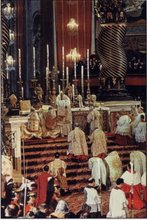
Last Monday, July 7th marked the on-year anniversary of the Holy Father's Motu Proprio Summorum Pontificum. With that in mind, I thought I'd make a long over due post on some liturgical experiences I've had recently.

After a late afternoon school function a few weeks ago I was looking for a place to get my daily prayers said. I was on a bit of a deadline (I had a date with my girlfriend), so I couldn't leisurely take my time. I went to the chapel in the priests' residence at my Alma mater but couldn't get all my prayers said due to a funeral. The near-by church was locked, so I went to the student chapel on campus. What I found disturbed me. People were in the chapel talking and visiting very loudly--which immensely annoyed me due to the fact that we were in the presence of Our Lord in the Blessed Sacrament--a band complete with guitars and drums, and an overhead projector and screen with the "hymns" displayed so people could sing along, which they did complete with upraised arms and swinging bodies. But I made do because it was the only place I had to pray. So I proceeded to pray my breviary, which wasn't particularly easy in my surroundings. In the middle of my praying of Vespers a priest in the Roman collar and jeans walked up to me and asked "Who's this guy praying up a storm?" I introduced myself and said I was just looking for a place to pray. He responded that I had found the right place. He informed me when I asked what was going on that the monthly "charismatic Mass and fellowship" was going on. When I found out who he was (he was known to me as the charismatic renewal priest of the diocese who happens to reside in the next-diocese-over--the same next-diocese-over where I attend an FSSP chapel), I informed him that I attend the FSSP chapel. His demeanor changed when he found that out, but it's a bit hard to describe in words just how. He didn't treat me like a second class citizen as some Novus Ordo priests would but rather treated me in a more formal manner, like the fact that I was a Traditionalist demanded a greater sense of formality than the others present. He invited me to stay if I wished, but said that I "might be a bit frazzled" (i.e. by the way Mass would be celebrated). I thanked him, and went back to my prayers. He proceeded to great others present, complete with large hugs. It goes without saying that I did not stay.

The other weekend I was out of town and wasn't able to get to the near-by Latin Mass for personal reasons, so I had to go to the local NO Mass. I knew I would be in for a show, but prayed I could just concentrate on the sacrificial nature of the Mass, not the liturgical shenanigans I would shortly view. We were greeted by the band (which just happened to stand next to the raised sanctuary in a particularly ugly church--nothing particularly Catholic about it), and were asked to say good morning to those around us. I stood rigidly and tried to ignore those around me until I was forced to acknowledge them by outstretched hands. The Mass itself was uninspiring with an altar girl, a "feel good" sermon that lacked anything touching real spirituality, numerous lay extraordinary Eucharistic ministers, and a very annoying old woman who went to the tabernacle (which happened to be stuck in an alcove at the backside of the church) both before and during the Mass with no genuflections, just a slight head bow. When asked how Mass was I said "My mother taught me that if I didn't have anything nice to say, not to say anything at all." I broke that admonition, and told all about my experience. I told the story of a parishioner at my chapel who's mother at one point had to work Sunday mornings and was not able to attend the TLM. She thus had to attend an NO Mass and said that she felt like she needed to go to confession after Mass because it made her so angry to see all the liturgical abuses. I felt much the same after my NO experience.

With these experiences in mind, might the Church need the TLM to mitigate all the liturgical chaos that happens nowadays? Just yesterday I was not able to attend my chapel for Mass due to personal reasons, but instead went to a much under-advertised TLM offered in an NO parish in my domiciled diocese. My diocese has for years been led by a bishop who resolutely refused permission for the indult Mass. It was so refreshing to have recourse to a beautifully celebrated TLM in the liturgical desert that is my home diocese, complete with cassock-wearing priest and transitional deacons! A portent of change perhaps?

One year later after SP much has been done, yet much has still to be done. Pray for our Holy Father Benedict XVI and for the success of Summorum Pontificum!

Sunday, May 25, 2008

On Being a Monarchist

I thought I would post an entry on being a monarchist, or rather on letting others know that I am a monarchist. Monarchists are such a rare breed here in America and hearing the experiences of another would perhaps have helped me admit to myself that I was a monarchist, that it was okay to think the way I did and that I didn't have to fear others' reactions.

When I first felt my faith in this Republic failing and my interest in monarchy as a more viable form of government, I was still in the military. I was deathly afraid to let anyone know lest I be persecuted by my fellow soldiers at the least, and at the worst be discharged (in retrospect my fears at the worst were rather unfounded but nonetheless truly felt). I let a few select friends and classmates know of my monarchist leanings, and of course found the blogosphere as an outlet for my beliefs. As time passed--and I was eventually discharged from the military due to a line-of-duty injury I incurred during a drill weekend--I began to let more people know of my beliefs.

As more time passed, I found that no one thought I was a freak, a lunatic, or crazy. In fact, to this day when I tell people that I am a monarchist the most common response is "What's that?" Most Americans simply don't know anything about monarchy as a working form of government. I explain my exact beliefs. They think it's unusual, different, interesting, even eccentric (but I must admit I can be rather eccentric at times), but no one has taken offense at my beliefs. Even with this blog (with the exception of a few uncharitable--and down-right jerk lunatics) I have not come across anyone who intellectually disagrees with me that does not respect my beliefs--they may disagree with my views, but they respect me for taking the time and effort to express those beliefs.

I don't know if any other monarchists here in America or any where else that monarchy is treated in a less-than-enthusiastic manner have experienced the same fears of expressing monarchist beliefs, but if so take courage. Letting the world know you are a monarchist isn't nearly as hard as it may seem (but I do advise you to be prudent in what you say and to whom you say it lest it hurt your current or future employment options). Don't be afraid to be yourself. If monarchy is to see a resurgence in this world, monarchists like you and I must be willing to let the world know that we are out there!

Saturday, May 03, 2008


Monarchy and Modern Europe


A reader recently suggested that I write a post on the prospects of a European-wide monarchy. I can't say that I see the prospects of one either likely or a positive thing for Europe.

Whether we monarchists like it or not (and this monarchist definitely does not like it!) Europe exists under the bureaucracy of the European Union, that democratic behemoth that seeks to spread it's flag over ever increasing territories. I don't see the prospects of the current ruling monarchies of Europe as rosy under the EU as it is: any monarchy that is a member nation of the EU will likely see further stripping of monarchical powers, more so than is already present. Under such conditions, how would one monarchy hope to gain power (real or otherwise) over the entire continent?

If a continental-wide monarchy were to exist, either the present monarchies would either have to be abolished or would see much of their already limited powers passed on to the European monarch. In addition, in those countries where the monarchy enjoys a modicum of popularity (such as the United Kingdom), the people would have to either give up their monarch or see him become even more of a figurehead than he already is. Can you imagine the British giving up their Queen for some continental monarch? I certainly cannot.

Many Catholic monarchists want to see the restoration of the Holy Roman Empire, stretching its fingers of power across the entire European continent. I must remind my readers that I am not an Austrian monarchist, but a German monarchist. I advocate the restoration of the German Empire (the Kaiserreich), not the HRE. While I would certainly like to see the restoration of the Austrian Empire in some form, I would not want this to include Germany proper. I, along with many German monarchists, would not want to see the Fatherland once again under the finger of an Austrian. The Hohenzollerns fought too hard in the past to thrust off the heavy hand of Austrian dominance to accept it once again.

In summary, while I certainly advocate the return of monarchy as the dominant form of government in Europe, I would not want such a return to include a European-wide monarchy. Let us monarchists set our goals along more small and reasonable lines.


Tuesday, April 15, 2008

Welcome Your Holiness!

The Holy Father, Pope Benedict XVI started his visit to the United States today. It makes this Catholic feel a great deal of pride and security knowing that the Supreme Pontiff walks upon the same soil as I do. I hope his visit is a safe one and spiritually edifying for his flock.

Even before his arrival a few minutes ago (at the time of this writing), the protesters came out of the woodwork. I've read the articles and seen the news reports of those protesting the Holy Father's arrival for one reason (or should I say agenda?) or another. Some protest because of the pedophile scandal that has plagued the Church. Others protest over doctrinal issues--some "ninja nun" (as my chaplain would say) was bitching about the Church's doctrine on male only priesthood. Some protest because they don't have any thing better to do. But to you, my readers (especially my Catholic readers), I encourage you to look beyond the protesters, shut your ears to the inane political commentary proffered by the news anchors, and listen to the words of the Vicar of Christ. When Peter speaks, we listen.

Sunday, March 30, 2008

Religion and Politics in the United Kingdom

There is a proposal before the British Parliament to abolish the Act of Settlement of 1701 that prevents any Catholic from ascending the throne or marrying a Catholic (read the article here). The topic of the Act of Settlement comes up often in monarchist circles, especially in those with a large number of Catholics.

At face value the Act of Settlement is an anti-Catholic law that restricts the rights of individuals who are in the line of royal succession to either convert to the one true Faith or from marrying a member of the one true Faith. It is a law based in political realities that are not now extant (i.e. the very influential nature of the Church in the political world), and at face vale seems rather bigoted and antiquated. It is, however, not that clear cut.

As I stated in my post on my ideal monarchy, my idea of a Catholic monarchy would be Catholic only, i.e. only Catholics would be able to ascend the throne, and no monarch or heir to the throne would be able to marry a non-Catholic. But I go even further than that. I make the stipulation that any member of the royal family who leaves the Catholic Church or marries a non-Catholic would be stripped of all royal titles and privileges. This is, admittedly, a biased piece of "law" against all non-Catholics. My reasoning for this is that I want a Catholic monarchy in perpetuity, not a monarchy that could lose it's Catholic identity due to the heretical influences of a non-Catholic monarch or non-Catholic in-law within the royal family. So while I do not agree with the anti-Catholic restrictions in the Act of Settlement, I certainly understand why those restrictions are there. The British monarchy is--unfortunately--a Protestant one, and it is entirely understandable that the powers that be within Britain want to keep it that way.

It is uncertain whether or not this proposal will go anywhere in Parliament. If I remember correctly, a similar proposal was before Parliament a few years ago and failed. There are also varying political implications with the abolition of the Act of Settlement (as described in the aforementioned article) that may complicate its repeal. Regardless of what happens the reality remains thus: if any heir to the British Crown sincerely wants to convert to Catholicism or marry a Catholic, he must make the decision whether his faith or lover means more to him than his crown. If such were or ever becomes the case in the British royal family, I hope that that member would choose his faith over his crown.

Monday, February 11, 2008

Election 2008

The clock ticks ever closer to the Presidential Election of 2008. The candidates have debated, they have slung accusations and claims at one another (both within and without the respective parties), millions of dollars have been spent, and many have already thrown in the towel and called it quits. So where do I stand, you ask? Some think that a monarchist would have no interest in a democratic election. Others think that, while I may have an interest, I would not take part in a process of government in which I have no belief. So, here's what I've got to say.

First of all, for a country that values democracy so much, we have a very undemocratic way of electing our presidents. I'm not talking about the Electoral College (although that too is a very undemocratic body, as the members of the College are allowed to ignore the will of their constituencies and vote as they please), but I'm talking about the primary process. Firstly, let's face it: only the rich can run for office. In order to get your party's nomination, you have to run a very aggressive campaign filled with television, radio, and print advertisements. You have to have money to travel to the fifty states to give speeches. Secondly, the media to a great degree determines which candidates are the front runners. If the media doesn't think a candidate has a chance, they simply don't cover that candidate in their coverage, or even worse dissallow that candidate from televised debates. Do you know that Alan Keyes is running under the Republican ticket? I didn't until quite recently--he's never talked about on the news and as been forbidden from the big debates on TV. Then factor in the fact that each state has different caucus/primary schedules. The result is that people in those states with later caucuses/primaries don't have the chance to vote for several candidates simply becuase by the time they get to vote said candidates have already dropped out. To some it up, if we truly believe in democracy and egalitarianism in this country, then why don't we have a truly democratic and egalitarian way of electing our leaders?

Now on to my own views regarding the candidates. I won't vote for any Democrat, since each and every one is a hands-down supporter of abortion. But the Republicans aren't much better. The Republican candidates are either pro-abortion to one degree or another, or claim to be pro-life but say that they woud "leave it up to the states" to decide if Roe v. Wade would be the law in their respective states. That's neo-con code for "I'll do nothing to stop abortion." Abortion is the worst, most terrible crime ever known to man. I don't care if Roe v. Wade is overturned by illegal or unconstitutional means. Heck, I don't even care if it's overturned by a military coup (as long as said coup is bloodless), I just want innocent babies to live! I'll have nothing to do with any candidate who supports it under any circumstance, and you know what? No self respecting Catholic should either. I will not choose the "lesser of two evils" by choosing a candidate who "would do less damage to the pro-life cause" than the opponent. We as Catholics can never do evil so that good may come from it. Since it's evil to vote for a pro-abortion candidate, I will not vote for the one who I think will do the least damage to unborn babies. I'd rather stay home with my conscious intact.

So in conclusion, if I had to make my decision now (which, by the way, Washington state doesn't vote until the 19th of this month), I'd have to say that I will vote, in the words of Richard Pryor's candidate in the movie Brewster's Millions, for "None of the Above!"

Friday, December 28, 2007


The End of an Era

The Nepalese Parliament has voted to abolish the Nepalese monarchy in an effort to appease the demands of Maoist forces within Nepal (see the article here). It's so terribly discouraging that a nation with a monarchy would bow down to the demands of godless Communists in abolishing a monarchy that has existed since 1769. When I first learned of this story, I felt absolutely discouraged as a monarchist. But I must persevere, as we all must. We can never see the return of monarchy as the standard form of government the world over if we give in to set-backs like this one. We must all fight a good fight, we must finish our course, we must keep the faith (cf. 2 Timothy 4:7).

Sunday, December 23, 2007

Christmas in Merry Olde America

I have been thinking a lot lately about the assaults against Christmas present here in America, although these same assaults are also present to one extent or another in most "Christian" countries.

What exactly is Christmas? It is the day the Christian world celebrates the Virgin Birth of our Lord and Savior Jesus Christ, the Second Person of the Holy Trinity; God Himself came down from heaven and became a man to save us men. So how do we Christians celebrate this holy and venerable day? By forgetting every reason we started celebrating this day in the first place.
Christmas has become a day of scandalous consumerism. The day we celebrate our Lord's birth has become a day for our capitalist societies to figuratively rape our economies--with, I might add, our complete and express permission. Giving gifts in honor of God's greatest gift to mankind is a noble and honorable act, but this practice has reached such extremes that for children--those usually best able to love and have faith in a God we cannot see--think of Christmas in terms entirely dependent upon their gift reception; Christmas is all about "gimme, gimme, gimme." In order to give, millions of people spend exorbitant amounts--often going in debt to do so--to obtain these gifts.

Then there is Santa Claus. Our present day picture of Santa Claus was invented in the 19th century by the American political cartoonist Thomas Nast. Some of our present legends of Santa are in fact loosely based upon the real St. Nicholas, Bishop and Confessor of the Church (died 343), but the real St. Nicholas never flew a sleigh led by flying reindeer through the sky delivering presents to good little boys and girls. What we have is the perversion of the memory of a venerable saint into a way for our consumerist society to make a buck.

My family thinks I'm a horrible person by planning on raising my future children (God willing) without a belief in Santa Claus. My theory is that firstly, Santa is a lie. Within Catholic moral theology, a lie, no matter for what the reason, is always objectively sinful. It's not a very good way to raise children under the pretense of a lie and expect them (once they learn of this lie, as all children do given time and age) to refrain from telling lies themselves. Secondly, as I stated earlier, children far too often think of Christmas simply within terms of getting presents. The belief in a supernatural/mythical figure who gives them presents on Christmas perpetuates this gift-centered view of Christmas. It is my opinion that in order for children to have a proper view of the seriousness and holiness of the day, they must be raised without the burdensome and objectively false belief in Santa.

Christmas is not a day to give gifts, it is not a day for families, it is not a day to experience a break from our work or studies. It is a day to commemorate the birth of our Lord. While Christmas experiences many assaults in our modern day, the holiness and spiritual reality of the day cannot be drowned out. Let us hold fast to the real meaning of Christmas: the day that the God who "...so loved the world, as to give his only begotten Son; that whosoever believeth in Him, may not perish, but may have life everlasting" sent His Son into the world. May the peace of the Christ Child be with you and yours this Christmastide.

Thursday, December 20, 2007

Dying Spain

I was watching DW-TV the other night (DW-TV is a German international news channel) and saw a report on the dwindling birth rate of modern Spaniards. While Spain is certainly not alone in Europe when it comes to low birth rates, the situation in Spain is especially severe. The government plans on giving couples €2,500 for each child born. What exactly brought about the situation whereby the Spanish government has to effectively bribe couples to have children?

The problem lies within modern Spanish culture (this problem is not just present in Spanish culture, but European culture at large). Spain is aborting and contracepting itself into oblivion. Spanish couples are choosing to ignore one of the two characteristics of marriage: procreation (the other being an institution designed to help each spouse help the other spouse get to heaven). One couple interviewed in the DW report especially caught my attention. This couple had no children, despite being visibly in their late forties (at the very least). The wife talked all about how expensive children are, but also pointed out the fact that children make it very hard to do what one wants to do in life--in other words children put a damper on one's social life. The husband said that he found children to be an unbearable burden and saw absolutely no reason to ever have children. I found myself thinking: "Hey buddy, you were a child once too. Good thing your parents didn't think that you were an 'unbearable burden.' "

The problem is this: married couples in Spain, Europe at large, America, and pretty much everywhere in the "Christian" world are selfish--they care for nothing but their own narcissistic interests. They do not realize that children are a blessing from God, not a curse to be avoided. All children should be loved, cared for, and cherished. If you are not willing to have children, then don't get married and pervert the nature of marriage.

I don't have children of my own, but I look forward to the day (God willing) when I find a wife of my own and start a (large!) family. I realize how important children are to the world: without children, the human race will die out.